


 English
 中文简体

+86-0575-8215 2808
/8200 8688/8239 2526
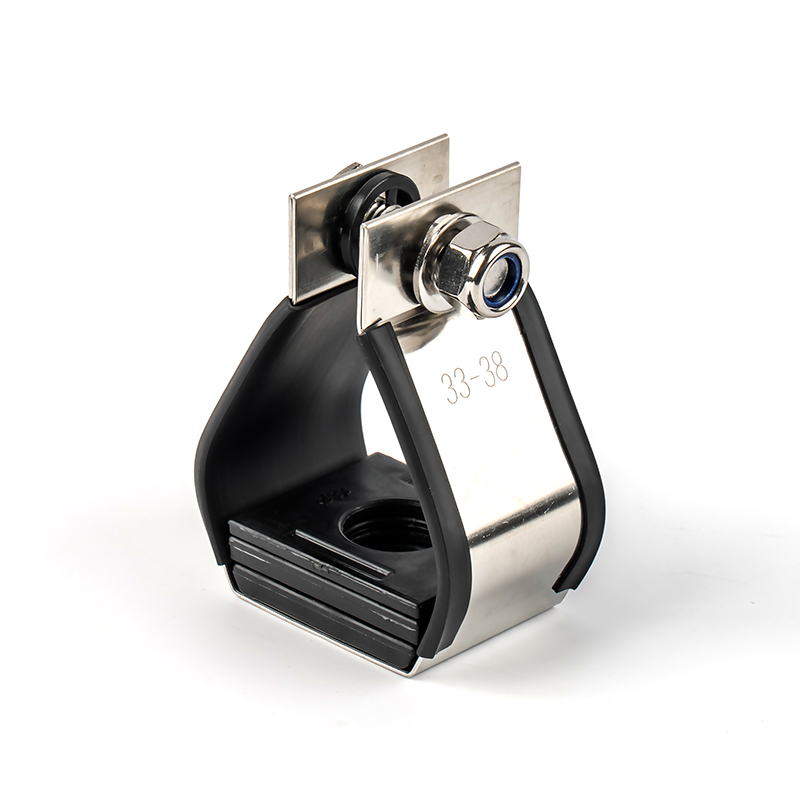
The single cable Cleats made of 316 stainless stee...
View more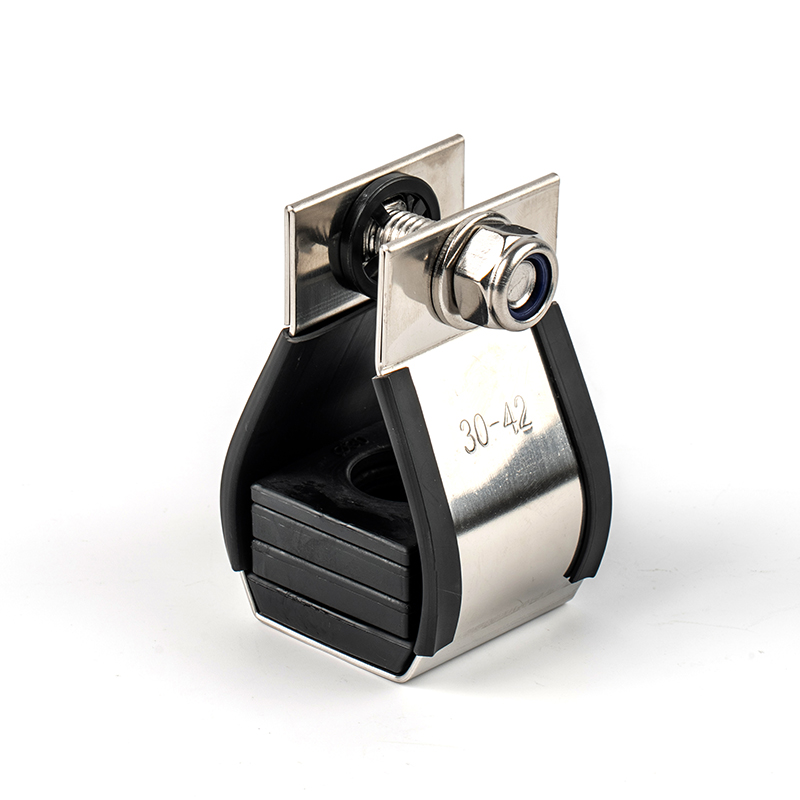
Manufactured from high-grade 316 stainless steel, ...
View more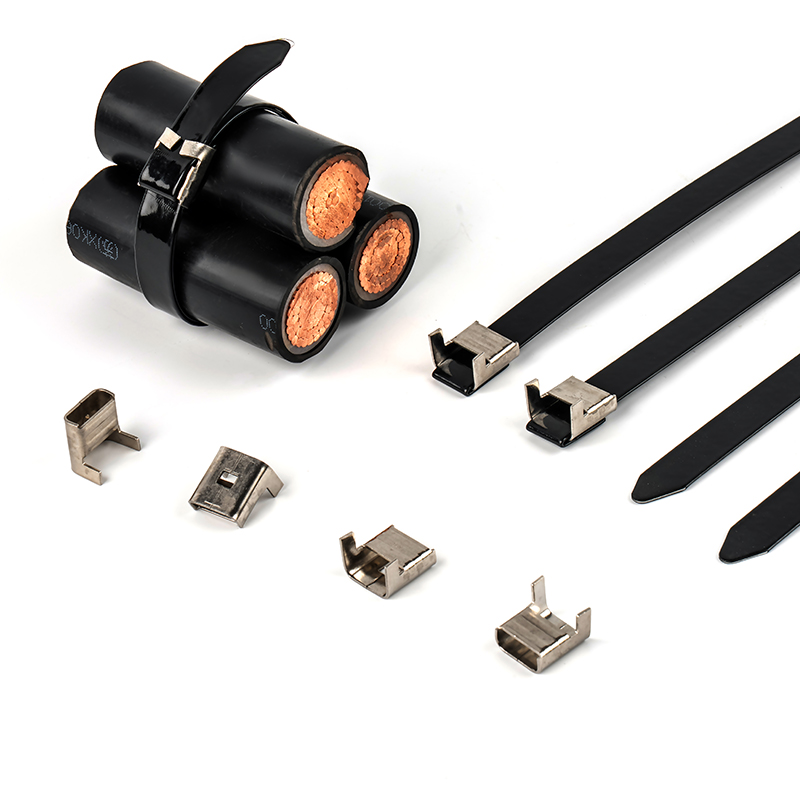
Brand Name: FengfanApproved Certificate: DNV &...
View moreContent
Six weeks after a coastal yard finished a cable tray retrofit, maintenance found the first snapped ties along the seaward run. The ties were ordinary black nylon, 4.8 mm wide, installed in full sun on a steel walkway that reaches 60 °C in summer. Nothing was defective about the product. It was simply the wrong material for ultraviolet light, salt fog and continuous heat.
The short answer: industrial cable ties are a material and tooling decision long before they are a price decision. A correctly specified stainless or acetal tie is a ten-to-twenty-year component with predictable pull strength; an underspecified nylon tie is a recurring line item in the maintenance budget. What follows explains where the dividing lines fall, which numbers on a data sheet actually matter, and what to settle before a purchase order goes out.
Three properties separate the two: loop tensile strength, the environmental envelope, and how repeatably the tie holds tension after installation. A 4.6 × 200 mm stainless band and a 4.8 × 200 mm nylon tie look similar on a bench. Under load, one holds 100 kg or more for two decades; the other creeps, relaxes and eventually fails at a fraction of its day-one strength.
Strength is only part of the story. Nylon absorbs moisture and can lose roughly 10–15% of its tensile strength when saturated; acetal is far less affected; stainless is indifferent. Add ultraviolet light, salt fog and 80 °C cabinet interiors, and the ranking changes again.
| Material | Loop tensile (typical) | Continuous temperature | UV and salt behaviour | Best fit |
|---|---|---|---|---|
| Nylon 6/6, black UV-stabilised | 8–55 kg, width dependent | -40 to +85 °C | Needs carbon-black stabiliser; strength falls after years of direct sun | Panels, cabinets, indoor bundling |
| Weather-resistant acetal | 10–50 kg | -40 to +90 °C | Low moisture uptake; keeps strength in humidity and sun | Telecom, outdoor signage, process plants |
| Stainless steel 304, uncoated | 100–250 kg | -80 to +500 °C | Corrosion resistant but can stain in chloride-rich air | General industrial, tunnels, high heat |
| Stainless steel 316, coated | 100–250 kg | -80 to +450 °C, coating dependent | Best pitting resistance; coating prevents galvanic contact | Offshore, shipyards, ports, rail |
A practical rule: indoors, in a dry cabinet, on a maintenance cycle that replaces ties anyway, nylon is cost-effective and fast to install. Outdoors, in a plant room, on a moving structure, or anywhere a service visit costs more than the tie itself, move up to acetal or stainless.
Within roughly 10 km of salt water, on an offshore deck, in a tunnel treated with de-icing salt, or anywhere the band sits against aluminium, specify 316 with a coated band. In clean industrial air, 304 usually does the job for less money.
The reason is metallurgical. Molybdenum in 316 raises resistance to pitting and crevice corrosion in chlorides. 304 performs well in dry, inland service but develops tea-staining and eventually pitting on marine sites. Neither grade degrades under UV, which is why stainless is the default where a nylon tie would be replaced every few years.
Coating solves a different problem. An uncoated stainless band pressed onto an aluminium tray, a galvanised ladder or a coated cabinet creates a dissimilar-metal couple, and the aluminium becomes the anode. A polyester, PVC or PPA coating breaks that contact, adds abrasion resistance where the band crosses a sharp tray edge, and gives you a colour code for circuit identification. PVC is the softest and has the lowest ceiling, around 80 °C; polyester covers the widest general range; PPA suits chemical splash combined with higher temperatures.
Ball-lock bodies are the workhorse for general bundling. A stainless ball seats into the embossed ladder on the band, so the tie locks at any point along its length rather than at fixed pitches, which makes variable-diameter bundles far easier to close neatly.
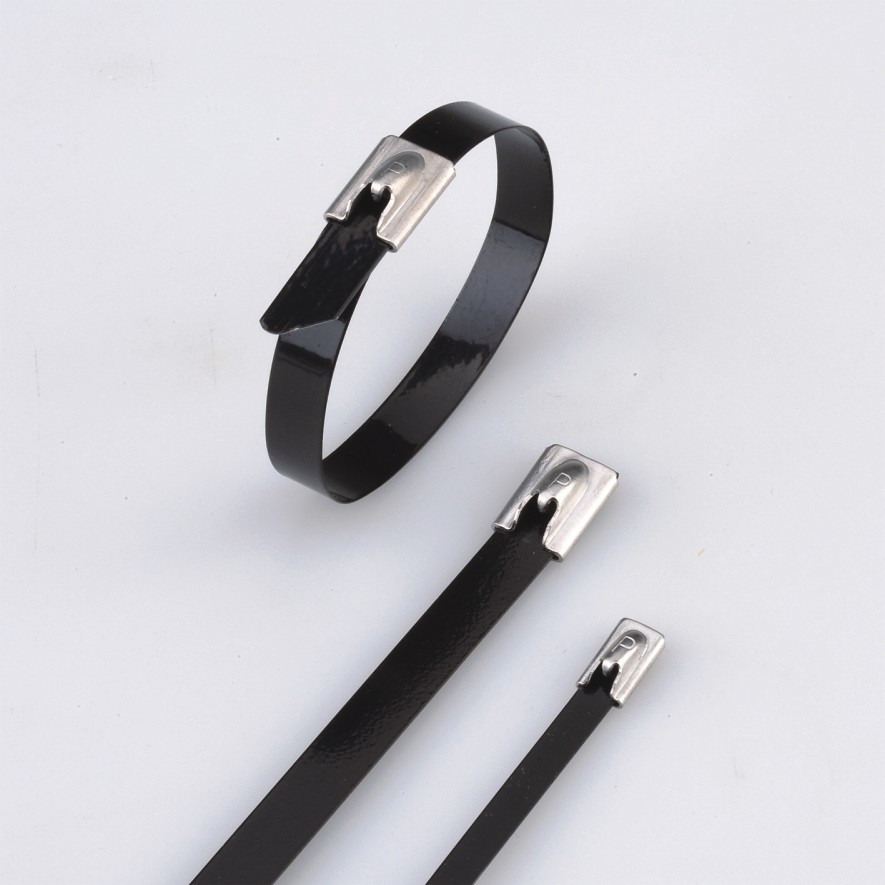 Polyester-Coated Stainless Steel Ball-Lock Cable TiesBall-lock stainless ties with polyester coating for general bundling; multiple width and strength options suit variable-diameter bundles and different tensioning needs.View Product →
Band thickness matters as much as width. Two ties at 7.9 mm width but 0.25 mm and 0.30 mm thickness will read differently on a tensioner and behave differently on a vibrating frame. If you are narrowing the choice between ball lock, ladder and L-type bodies, this guide on how to choose stainless steel cable ties walks through the trade-offs in more depth.
Two ties with identical band width can behave very differently on a machine frame that vibrates. The lock decides whether tension survives the first week.
Where a cable may need to be re-entered, a releasable body costs more per piece but eliminates destructive removal, which is usually the cheaper outcome across a project lifecycle.
A 7.9 mm stainless band tensioned by hand reaches perhaps 40% of the tension a calibrated tool applies, and the gap shows up as loose bundles after the first vibration cycle. The opposite error is just as common: a nylon tie pulled by a fixed-grip gun onto 1.5 mm² control cable can cut the insulation before the operator notices.
Three settings deserve attention during commissioning. First, tension: a dial that holds its setting across a shift, not a lever that drifts. Second, cut-off: the tail must be trimmed flush, because a sharp stainless burr is a hand injury and a chafe point against the next cable. Third, access: a three-way or rotating handle is worth the extra cost in congested trays where a straight tool will not fit.
 LQD Stainless Steel Cable Tie Tensioner with 3-Way HandleHand tensioner for stainless steel cable ties up to 19 mm wide, with a three-way handle for tensioning and flush cut-off in confined trays.View Product →
Pair the tool with the tie family rather than the other way round. A tensioner designed for a ball-lock band will not crimp a ladder lock correctly, and nylon tension tools with adjustable stops are a separate purchase entirely.
Ask for these eight items in writing. A supplier who cannot answer them is quoting a commodity, not a specification.
One clarification saves rework: ties bundle cables, cleats carry fault-current forces. Short-circuit withstand is a type-tested property of the cleat, verified to IEC 61914, and no tie — however strong — substitutes for it. Where a project mixes both, order them together so fixing centres and band widths line up. Reviewing the supplier's full set of cable ties, cable cleats and installation tools in one pass is usually faster than sourcing each category separately.
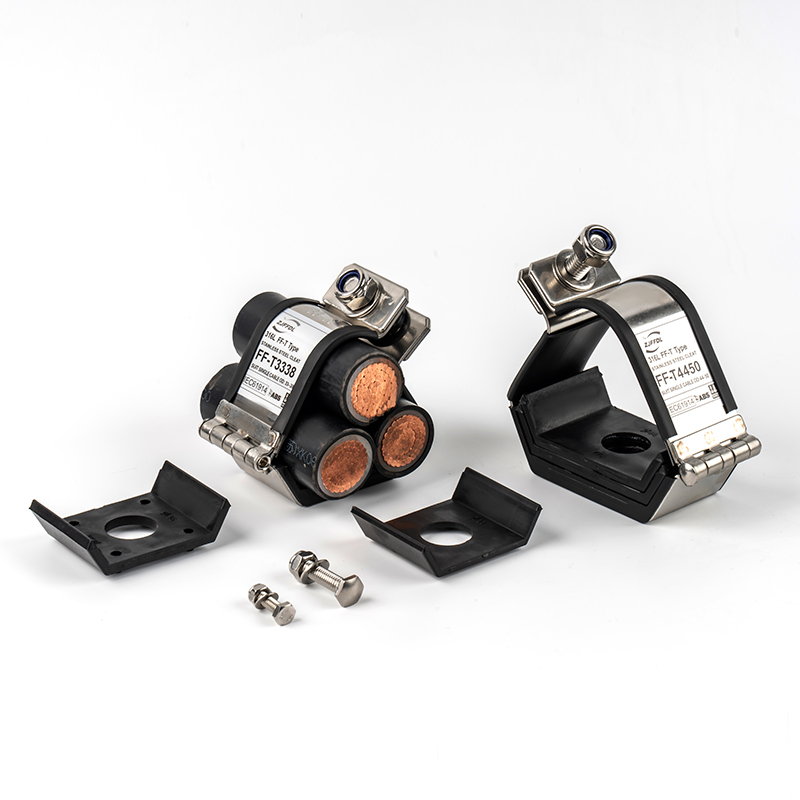 316 Stainless Steel Trefoil Cable Cleats, ER SeriesTrefoil cleats in 316 stainless steel for cable tray retention and short-circuit damage prevention, with 24 sizes spanning 13–128 mm cable diameters.View Product →
Manufacturers with in-house stamping, coating and assembly generally hold tighter tolerances and can match a tool to the exact band they produce, which is where most field failures originate.
Yes, typically by a factor of three to ten on loop tensile, depending on band width. More important than the headline number is that stainless does not creep under sustained load the way nylon does.
Black UV-stabilised nylon can, but treat it as a consumable with a finite service life rather than a permanent fixing. For anything above 10 years, or near salt water, acetal or stainless is the safer specification.
Start with 4.6 mm for light harnesses and 7.9 mm for anything carrying its own weight or exposed to vibration. Check contact pressure on soft jackets and keep the minimum bend radius of the cable in mind — a tie pulled hard around a tight radius does more damage than an under-tensioned one.
Not strictly, but hand tensioning is inconsistent above about 4.6 mm width. A calibrated tensioner with a flush cutter gives repeatable tension and removes the burr that causes both hand injuries and cable chafe.
The single cable Cleats made of 316 stainless steel is used for cable management. It is corrosion-resistant, high-temperature resistant and meets international standards. It is suitable for various ha...
See Detail
Manufactured from high-grade 316 stainless steel, this cable management system is specifically designed for secure cable retention in power generation, petrochemical, marine, offshore platforms, and c...
See Detail
Brand Name: FengfanApproved Certificate: DNV & ABS.Product Description: Cable Fixing Band and ClipsThe Lower Cost Alternative to Cable Cleats Product Benefits- Low profile finish- 316 grade stain...
See DetailMobile: +86-136 7685 3958
Email: lihai.fan@zjffdl.com
Mobile: +86-188 57530390
Email: alan.huang@zjffdl.com
No. 1116 Yasha Ave, Cao’e Street, Shangyu District, Shaoxing City, Zhejiang, China, 312300


+86-0575-8215 2808
/8200 8688/8239 2526

+86-0575-8215 2066
Copyright ©Zhejiang Fengfan Cable Fittings Co.,Ltd.
